



How Is Hash Made? From Flower to Slab (2026)

This article is for information purposes only. All SmokyHUB products are aromatic products made from industrial hemp, they are not medicines, and they are intended exclusively for adults.
Quick answer (for those in a hurry)
Hash is made in two steps: first, the resinous trichomes are separated from the hemp flowers — by dry sifting, hand-rubbing or with ice water — and then the collected resin is pressed into slabs with warmth and pressure. No chemistry, no solvents: just the plant, a screen, hands and pressure. With CBD hash the raw material is industrial hemp with less than 0.3% THC, so the final product is not psychoactive. Below we explain each step and the three traditions today’s methods come from. 👇
It all starts with the flower
The most important truth about hash is also the simplest: you cannot make good hash from bad flowers. The resin you will eventually hold in your hand is merely a concentrate of the trichomes that grew on the bud — if the flower was dried badly, harvested too early or stored wrong, all of it carries over into the slab. That is why hash production really begins in the field: with a healthy plant, the right harvest moment and slow, patient drying.
What trichomes are and why everything revolves around them, we explained in What is CBD hash?, and the relationship between flower and resin in CBD hash or hemp flowers. Here we go one step deeper: into the workshop itself.
A short history: from caravans to workshops
Hash is as old as the trade routes between the East and the Mediterranean. The first records of pressed hemp resin come from Persia and Arabia, from where the knowledge spread towards India, Lebanon, Egypt and finally Morocco, which became synonymous with sifted hash in the 20th century. Every region developed its own signature: Lebanese “red” and “yellow” hash named after the colour of screens and curing, Afghan dark, hand-kneaded pieces, Nepalese charas from fresh plants. Today’s CBD hash is the direct heir of these traditions — only the raw material is industrial hemp, while the methods remain the same.
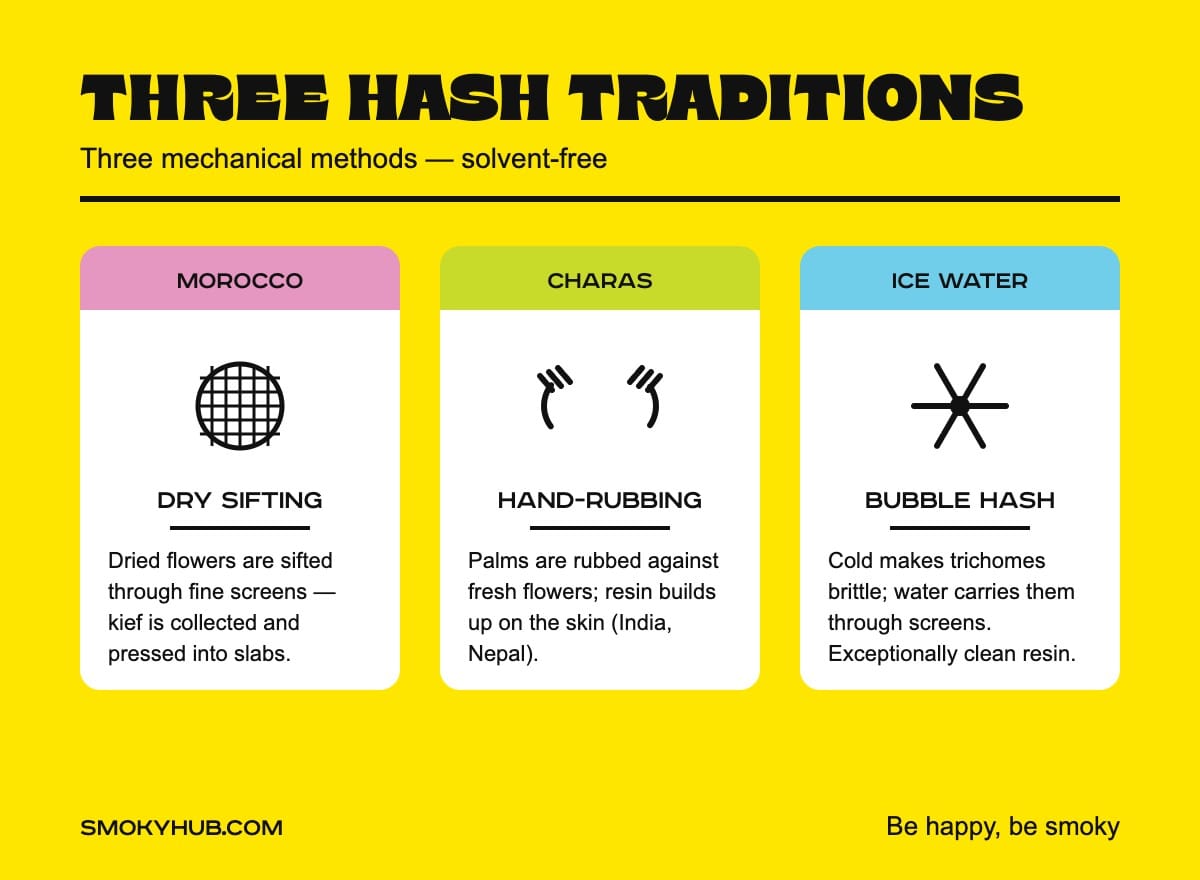
Step 1: separating the trichomes — three traditions
Dry sifting (Morocco)
The classic from the Rif mountains. Fully dried flowers are gently shaken and rubbed over fine screens — trichomes are harder and more brittle than plant tissue, so they break off and fall through the mesh. The result is a golden-brown dust called kief. The first, finest sift gives the purest fraction (the “first pull” in jargon), while every following one contains more plant particles. That is why Moroccan hash from the same producer can vary a lot — the fraction decides the purity.
Hand-rubbing (charas — India and Nepal)
The oldest method of all: palms are slowly rubbed against living, unharvested flowers, and the sticky resin builds up on the skin until it is rolled into dark balls or “sticks”. The process is slow — an experienced collector gathers only a few grams in a whole day — which is why charas has always been considered precious. It differs from sifted hash in coming from the fresh plant, which gives it a different, greener, more perfumed character.
Ice water (bubble hash / ice-o-lator)
The modern but still fully mechanical path: flowers are soaked in ice water and stirred gently. The cold makes the trichomes glass-brittle so they snap off, and the water carries them through a series of ever-finer screens. The collected “sand” is dried and, if desired, pressed. The result is exceptionally clean resin — and since the only “solvent” in the process is plain water with ice, the method stays true to the no-chemistry principle.
Step 2: pressing
Collected kief or dried water hash starts out as a loose, powdery material. Pressing is where the transformation happens: under warmth and pressure the trichome heads burst, the resin fuses into a single mass, the surface slowly oxidises and darkens in the air while the inside stays lighter and softer. Traditionally this is done with nothing but palms and persistence — hence the term hand-pressed.
Pressing is often followed by a short curing period: the slab rests for a few weeks somewhere cool and dark so the aroma binds and rounds off — much like flowers cure after drying.
What decides the quality of the final hash?
- The raw material (80% of the result): healthy, ripe, slowly dried flowers with a rich trichome coat.
- Fineness of the sift: a finer screen means fewer plant particles and cleaner resin — but a smaller yield.
- The maker’s hand at pressing: an under-pressed piece falls apart, an overheated one loses its aroma.
- Curing and storage: a few weeks of rest somewhere cool rounds the aroma off; wrong storage destroys it.
- Paperwork: the batch’s lab analysis is the only objective proof of purity and compliance.
Why “hand-pressed, solvent-free” is not a marketing phrase
All three paths described are mechanical: they separate the trichomes by sifting, rubbing or cold — not by dissolving them in chemical solvents. Solvent extractions do exist, but those are industrial processes for entirely different product types, with their own risks and strict equipment. When our packaging says “hand-pressed, solvent-free”, it means: the slab contains exactly what grew on the flower — resin, terpenes and nothing else.
How the method shows in the final piece
- Colour: finely sifted, lightly pressed kief gives lighter, golden-brown pieces; heavily pressed and more oxidised resin is dark brown to almost black.
- Texture: dry-sifted hash is often crumbly, water hash and heavily pressed pieces are dense and pliable like wax.
- Aroma: the fraction and the freshness of the raw material decide whether the scent is bright and floral or deep, earthy and spicy.
You can see all three on our shelf: CARRY LIFT hash is lighter and angular, BOB MELLOW hash warm brown and pliable, SLEEPY JOE hash almost black and compact. Three pieces, three process signatures.
From field to shelf at SmokyHUB
Our hash is made from lab-analysed batches of industrial hemp, hand-pressed and solvent-free — every batch comes with a lab report confirming the cannabinoid content and compliance with the THC limit. We sell it as an aromatic product, exclusively to adults. Not sure which one is yours? Take the quiz →
Frequently asked questions (FAQ)
Is anything added to hash?
Not to a quality one. A real slab is nothing but the pressed resin of the flowers — no binders, colourants or additives. That is exactly why the batch lab analysis matters: it confirms the piece contains only what belongs there.
What exactly is kief?
Kief is the dust of broken-off trichomes produced when dried flowers are dry-sifted — the raw material that pressing turns into hash.
Why do hashes come in different colours?
Because of the strain, the fineness of the sift, the degree of pressing and the oxidation of the surface. Colour by itself is not a quality grade — a light and a dark piece can both be excellent, just different.
Does ice water hash mean lower quality?
No — rather the opposite: the water method yields very clean resin. Its character simply differs from dry-sifted hash, so the choice is a matter of taste, not a quality ladder.
Is making CBD hash legal?
Yes, when the raw material is industrial hemp with less than 0.3% THC and the product is marketed in line with the regulations — as an aromatic product for adults. Details in our guide to the legality of CBD.
Can I make hash at home?
The methods are public knowledge and mechanically simple, but they only make sense with larger amounts of quality flowers — and the raw material is everything. If you mostly care about the result, a hand-pressed piece from an analysed batch is the much shorter path.
Be happy, be smoky. 💛
SMOKY QUIZ
WHICH SMOKY ARE YOU?
Carry Lift, Bob Mellow or Sleepy Joe? Take the 2-minute quiz and find your character — a little gift is waiting too. 😉
Take the quiz →Contents